
An introduction to ocean acidification
What causes ocean acidification?
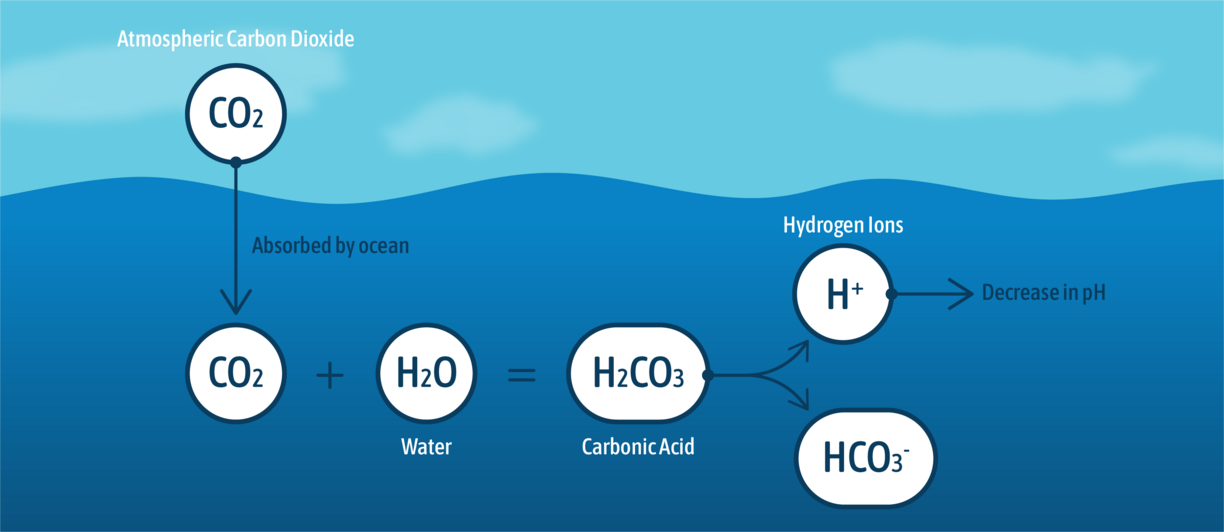
The ocean absorbs around 30% of global CO2 emissions every year! This helps mitigate climate change, but it also has an impact on the acidity of the ocean. More carbon emissions means more dissolved carbon dioxide and more acidic seawater.
What is acidity?
Pure water (H2O) has an even number of Hydrogen ions (H+) and Hydroxide ions (OH-). This means it is neutral. When a solution has more Hydrogen ions (H+), it is acidic. When a solution has more Hydroxide ions (OH-), it is basic.
How does carbon dioxide make seawater more acidic?
When carbon dioxide reacts with seawater, it creates carbonic acid (H2CO3). Carbonic acid releases Hydrogen ions (H+), making the seawater more acidic.
A quick lesson on pH
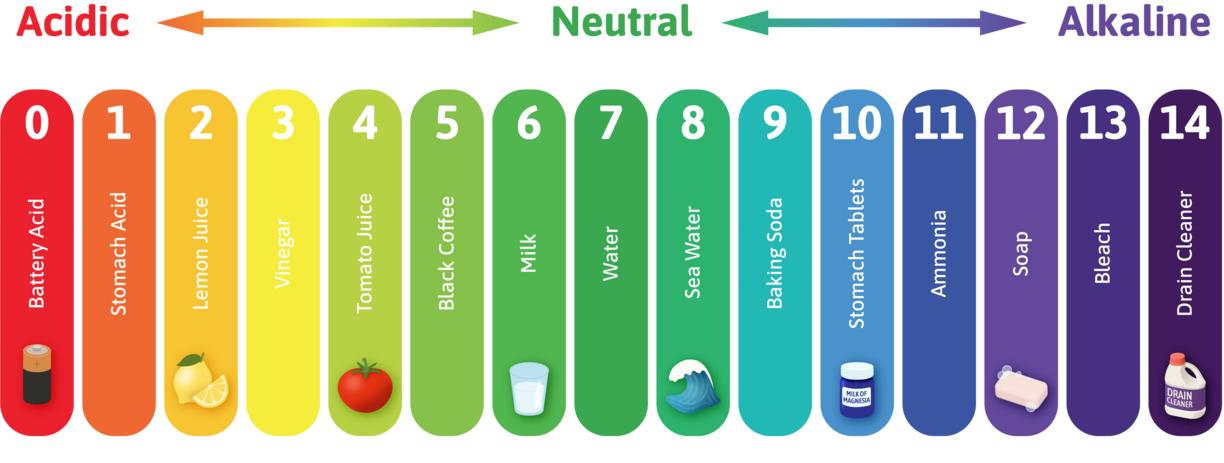
The pH scale measures the acidity of a solution. The scale goes from 0 to 14. 0 is very acidic, 7 is neutral, and 14 is very basic (or alkaline). Seawater is on the basic side of the pH scale.
What is ocean acidification?
Ocean acidification occurs when seawater becomes more acidic than it was before. For example, if seawater in an area drops from an average pH of 8.5 to an average pH of 8, it has become more acidic. Ocean acidification does not mean the water has an acidic pH (less than 7). It does mean that the pH has gone down.
Going down the pH scale, each whole number is 10x more acidic than the last. For example, a solution with a pH of 4 is 10x more acidic than a solution with a pH of 5. This means small changes in pH can represent a significant change in acidity.
What happens when the ocean gets more acidic
Ocean acidification tends to be particularly stressful for animals with shells. More acidic waters can make it harder for shellfish to build and maintain their shells. It can also affect feeding, metabolism, growth, reproduction, disease resistance, and overall survival. This can lead to issues up the food chain for animals that eat shellfish, including otters, birds, sea stars, octopuses, and humans.
Check out this poster from Canada's Ocean Acidification Community of Practice highlighting the impact of ocean acidification on the Pacific oyster.
Researchers are breeding more resilient shellfish for the future
Baynes Sound is a uniquely acidic environment, making it a prime location for researchers to monitor and investigate the effects of ocean acidification.
Researchers in Baynes Sound are working to help farmed shellfish, like oysters, survive more acidic conditions.
The summer is a dangerous time for shellfish. Various factors work together to create a stressful environment. These factors include marine heatwaves, viruses, bacteria, and acidic waters.
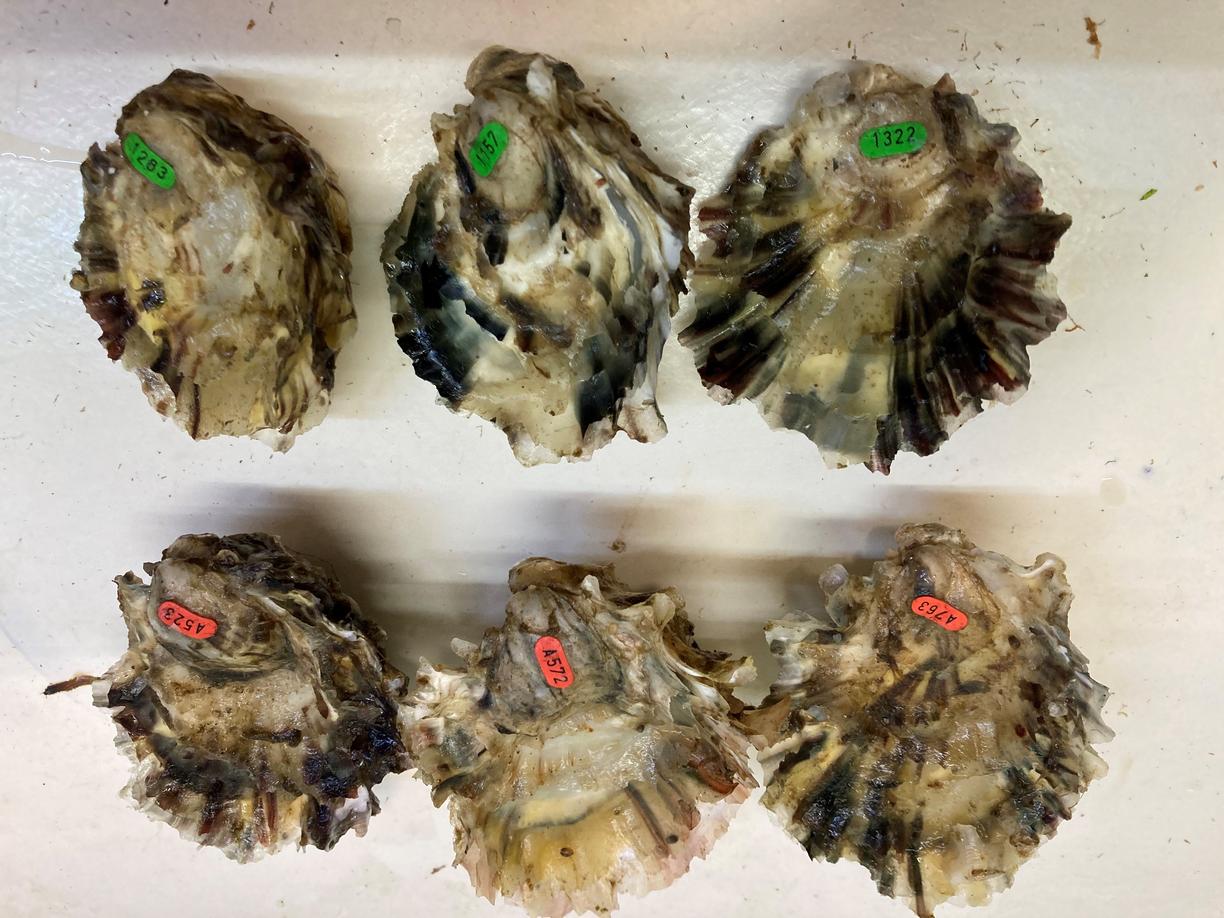
Not all shellfish respond the same way to these stressors. Some are able to cope better than others. Hatcheries identify then breed individuals with natural resilience. This leads to stronger, healthier shellfish that are better able to cope with changing ocean conditions.
What traits help shellfish survive ocean acidification? Strong shells, ability to control internal systems, and efficient energy use.
Shellfish need to survive the summer, but they also need to sell on the market. Commercially important traits like growth rate and shell shape are also selected for. This helps keep farmers and consumers happy.
Check out this video from Rogers TV highlighting Deep Bay’s breeding program.
For more information, check out Deep Bay's selective breeding program page.
Research papers
Barclay, K. M., Gurney-Smith, H. J., Ahmed, M., Christian, J. R., Cyr, F., Duke, P. J., Else, B. G. T., Gimenez, I., Lizotte, M., Reader, M. C., Roth, M., Rutherford, K., Starr, M., Steiner, N. S., Turner, J., VanderZwaag, D. L., & Evans, W. (2026). Ocean acidification in Canada: The current state of knowledge and pathways for action. Frontiers in Marine Science, 13, 1761703.
Evans, W., Pocock, K., Hare, A., Weekes, C., Hales, B., Jackson, J., Gurney-Smith, H., Mathis, J. T., Alin, S. R., & Feely, R. A. (2019). Marine CO2 Patterns in the Northern Salish Sea. Frontiers in Marine Science, 5(Journal Article).
Jarníková, T., Ianson, D., Allen, S. E., Shao, A. E., & Olson, E. M. (2022). Anthropogenic Carbon Increase has Caused Critical Shifts in Aragonite Saturation Across a Sensitive Coastal System. Global Biogeochemical Cycles, 36(7), e2021GB007024.
Mackenzie, C. L., Pearce, C. M., Leduc, S., Roth, D., Kellogg, C. T., Clemente-Carvalho, R. B., & Green, T. J. (2022). Impacts of seawater ph buffering on the larval microbiome and carry-over effects on later-life disease susceptibility in Pacific Oysters. Applied and Environmental Microbiology, 88(22).
Moore‐Maley, B. L., Allen, S. E., & Ianson, D. (2016). Locally driven interannual variability of near‐surface pH and Ω A in the Strait of Georgia. Journal of Geophysical Research: Oceans, 121(3), 1600–1625.
Nordio, D., Khtikian, N., Andrews, S., Bertotto, D., Leask, K., & Green, T. (2020). Adaption potential of crassostrea gigas to ocean acidification and disease caused by vibrio harveyi. ICES Journal of Marine Science, 78(1), 360–367.
Simpson, E. (2024). Variability and Drivers of Nearshore Carbonate Chemistry and the Vulnerability of Coastal Communities to Ocean Acidification in British Columbia [Dissertation]. Simon Fraser University.
Simpson, E., Ianson, D., & Kohfeld, K. E. (2022). Using End‐Member Models to Estimate Seasonal Carbonate Chemistry and Acidification Sensitivity in Temperate Estuaries. Geophysical Research Letters, 49(2), 1–12.
Simpson, E., Ianson, D., Kohfeld, K. E., Franco, A. C., Covert, P. A., Davelaar, M., & Perreault, Y. (2024). Variability and drivers of carbonate chemistry at shellfish aquaculture sites in the Salish Sea, British Columbia. Biogeosciences, 21(5), 1323–1353.
Wright-LaGreca, M., Mackenzie, C., & Green, T. J. (2022). Ocean Acidification Alters Developmental Timing and Gene Expression of Ion Transport Proteins During Larval Development in Resilient and Susceptible Lineages of the Pacific Oyster (Crassostrea gigas). Marine Biotechnology (New York, N.Y.), 24(1), 116–124.